

The Neon Hangover: Dublin’s Digital Glow at the Edge of the Crash
The Great Recession was not, on the face of it, a golden era for anything. But for public art in Dublin, it turned out to be exactly that. The opening period of the crash in 2008-2009 was a topsy turvy time - we knew the Tiger had run out of steam, but we didn’t know where it’d fall, or, indeed who’d been wagging the tail all along. Fianna Fáil were still, somehow, in power. Brian Cowen was in the hotseat. Terms like “bank guarantees” were flying in the air, which sounded terrifying, but most people didn’t know exactly what to even protest against yet. Bertie was out the door and his political machine was juddering to an ignoble halt. Things were bad, and most of us were waiting to see exactly how things would get worse. Feeling uplifted? Good, let’s dig in.
Despite all this, or rather, perhaps because of the economic excesses, Dublin during this time was immersed in visual splendour. It was a time of truly mesmeric public art: site-specific, imaginative, beaming a forward-thinking vision out to the world… while households across the country set about remortgaging.
It’s an oft-spoken maxim that art anticipates the near future, that it taps into undercurrents in societies and projects them before politics has caught up. Though there was some pointed satirical art in the mix, mocking the materialists we’d become, that hardly made a blip on the radar when cheap credit permitted zooming around in Mercs and snapping up gaffs in Bulgaria. In terms of government funded public art, the true dividend of all that wealth only hit its stride when things were already careering off a cliff.
As a young student in the city, a first timer living in the capital, this was the visual world I stepped into. The city was a feast for the eyes; at the time I figured this was its typical look. In retrospect, it merely turned out the residual excesses of the gangbusters economy had left us with a few sparkly and imaginative goodbyes.
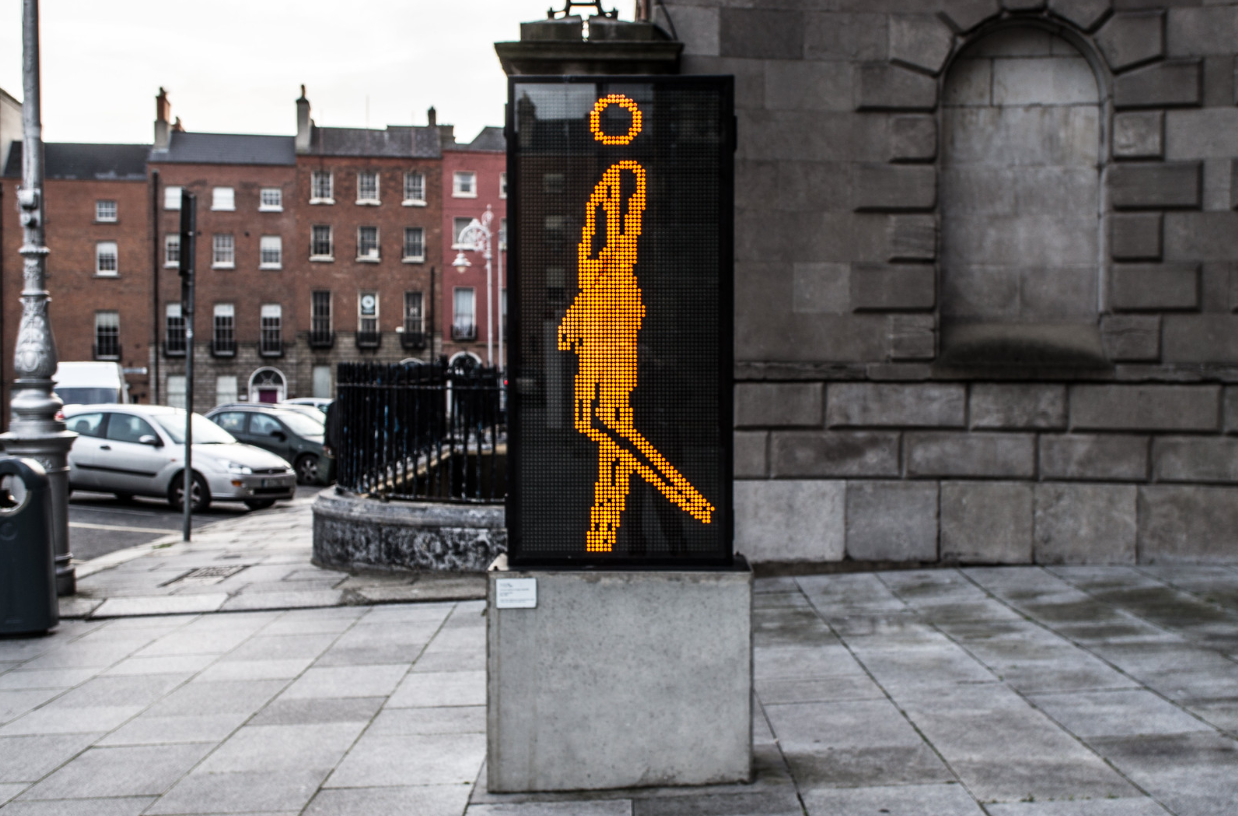
“Suzanne, Walking” - outside the Hugh Lane Gallery, Parnell Square
Opie’s Sauntering Strangers
Perhaps the most iconic work of art at this time was Julian Opie’s magnificent“Walking on O’Connell Street” (2008-9) series of digital sculptures. These were four rectangular LED panels, each almost 2 metres tall, showing digitised human figures striding down the city’s main thoroughfare. While they were visually intriguing just as a feature of the city, it was the particular way of walking that set them apart in terms of public digital art. With a cool, calm, confident demeanour, these life-sized digital flaneurs walked to their own beat. They were playful and self-assured. European, cosmopolitan, they crystallised an attitude that Ireland had been developing for some time: we’re here, we’re counted, we’re no longer a place where people flee from for opportunities; we’re a hub for the soul of modern life. For all the world, it appeared like the figures from pedestrian lights jumped off their perch and strolled with us. Since Dubliners tend to ignore pedestrian lights anyway, and jaywalking is a bit of a national pastime, it made us take notice of these signage-like beings with fresh eyes.
Though at the time intended to be keenly relatable to us in their cocksure walk, in retrospect, they feel like ghosts from the grimly recent past. First arriving on the street in January 2008, they may have had a brief period of symbolising Ireland’s confident strut on the world stage, but by the end of the year, their nonchalance seemed to suggest something else: “we’ve no idea where this is headed… but we’ll carry on regardless.” Dutifully practicing mindfulness, I guess, but before that phrase would have made any sense.
Actually, these were meant to have a more limited life on the street shelf. They were installed as part of the centenary celebrations for the Hugh Lane Gallery and were scheduled to be removed in October 2008. As it happened, they were enormously popular and were kept in place until well into late 2009. Maybe we needed a sense that someone knew where they were going…
Moving from Waterford up to the big smoke, I was lucky enough that my student dorms were in the revamped docklands area of Mayor Square. Unlucky, however, that by the time I moved in, the impending doom ensured it was a new, yes, but mostly soulless and barren space lacking much retail action and related footfall.
The economic boom had taken a fair hold of the southside, but on the northside, the vibrancy hadn't caught up with the architecture yet. Bereft of much buzz down by my dorm building, I often strolled up through Talbot Street to the Spire to take in the sights around there. In my head, and accompanied by Opie’s digital screens, I felt like I was in Times Square, with hay perched between my teeth and a loose flannel shirt, silently mouthing “my, my, my…”.
The four figures that strode down O’Connell Street were named Suzanne, Sara, Julian, and Jack. Four modern denizens going nowhere fast but, clearly, loving the journey. They mimicked the relentless flow of commuters on Dublin's main thoroughfare, yet walked with the easy assurance of a city that had spent a generation accumulating wealth, foreign investment, and the quiet confidence that comes with no longer being the poor relation of Europe.
These double-sided LED monoliths were positioned along the central median of O'Connell Street, meaning the figures were visible to traffic and pedestrians moving in both directions. A fifth figure, another version of "Sara," was placed outside the Hugh Lane Gallery on Parnell Square, giving a modern jolt of life in front of the grand Georgian townhouse, formerly Charlemont House, now home to the city’s municipal art collection. In this monolith, she wasn’t just walking, but doing a funky dance. Mad craic altogether!
The figure, “Julian”, was indeed the artist himself, and his own real stride, brought into digital form. A clever work-within-the-work within a wry piece by the artist; walking on by, invisible, hiding in plain sight, giving us the nod.
Julian Opie has a nice range of inquisitive and playful public art that plays with signage, such as Escaped Animals - deadpan official-looking signs depicting outline animals forms placed in clusters - which was shown around Gateshead, UK, in partnership with the BALTIC Centre. He had also previously worked on moving LED human form digital works before, such as “Ann, Dancing” which was installed in Minneapolis in 2007. Opie's pop sensibility was not new to Irish audiences - he had designed the cover for Blur's Best Of compilation, a dainty piece in the Pop Art mould that many will recognise without knowing his name.
While Julian, Jack and Sara were ultimately packed up and carted off to gallery settings beyond these shores, Suzanne found a permanent home in our fair city. Almost twenty years on, she's still striding away outside the Hugh Lane on Parnell Square - the spot previously occupied by the dancing Sara - now going by the rather more specific title of 'Suzanne Walking in a Leather Skirt.' Personally, it’s one of my favourite pieces of public art in the city. A tender tribute to a time when public art in the city was realistically more adventurous, yet which is still relevant - modern life hasn’t slowed down since then, far from it, but Suzanne keeps the same pace, strolling on; unhurried, peaceful, entirely in her lane. It makes me want to stop racing every orange pedestrian light, take a leaf out of her book, and take in the beautiful city at a more relaxed pace.
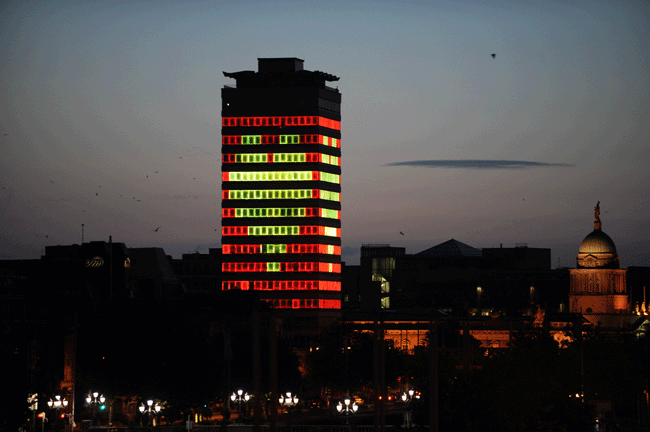
Photo credit: Dublin Theatre Festival Archive
Liberty Hall Flirts with the 21st Century
Winding one's way south from The Spire and onto the quays, the city had another trick up its sleeve. Liberty Hall - all 59.4 metres of it - was alive with light. Each of the roughly 300 windows ringed with LEDs, paired together in a cascade of shifting colour; the building had been turned into something that stopped you in your tracks. For Ireland, this was very large scale indeed. Standing at 17 floors, the building - headquarters of Ireland's main trade union, SIPTU - had long dominated the view upriver. Several buildings have since overtaken it, but it remains a prominent fixture on the northside skyline, albeit nowadays in quite a sorrier state than its 2009 glow up.
Featuring over 100,000 LEDs in total, Playhouse - as the project was called, staged as part of the Dublin Theatre Festival - turned the skyscraper into a giant, low-resolution screen of moving colour. A pleasurable assault on the senses, it illuminated the quays far and wide each night, transforming a building typically dismissed as one of Dublin's more unfortunate architectural inheritances into something genuinely dazzling.
The building's supposed architectural weakness - that slightly clunky grid of individual windows - became the canvas. Where a more modern curtain-wall glass block would have offered nothing to work with, Liberty Hall's window grid provided exactly the pixel structure the installation needed. The irony runs deeper than it first appears: Liberty Hall was not always the drab presence it had become by the noughties. In its original 1965 form, the building had a delicate translucent quality - alternating layers of white mosaic floor-plates and illuminated office interiors that caused the floors to appear to float at night. It was a UVF car bomb in 1972 that changed all that, blowing out most of the glazing. The replacement glass came with reflective film, the mosaics were later covered in putty, and a building that had once glowed quietly on the quays gradually greyed into the skyline. Playhouse, in a sense, gave it back its light.
The project was inspired by Project Blinkenlights, a video game-themed light installation that had transformed the brutalist Haus des Lehrers building on Berlin's Alexanderplatz in 2001. Like Alexanderplatz, an area defined by its grey mid-century aesthetic, Liberty Hall offered a similar proposition: what happens when you give a resolutely unfashionable building a reason to be looked at again. The answer, in both cases, was: quite a lot.
The installation was the brainchild of Brian Fallon, creative lead and the primary driving force behind the project, working alongside video designer and filmmaker Jack Phelan. The project had its origins in conversations at Science Gallery Dublin - one of the more quietly significant cultural legacies of the Celtic Tiger years, and a loss to the city when it closed its doors. Irish director Eoghan Kidney, who worked on the project, later directed Underworld's music video for "Downpipe" using the Playhouse installation as its centrepiece; more on that in a moment. The main sponsor was, in a detail that requires no further editorialising, Daft.ie - Ireland's biggest property listings website, backing an art installation on the side of a trade union building, during the final shuddering days of a property bubble.
It was also interactive. Members of the public could go online and submit their own animations to be displayed on the building's facade. Like a lot of great light art, pictures don't do the work justice. So hats off to the boyos from Underworld for making it the cornerstone of that video mentioned. Check it out below for a look at the scale and vibrancy of how it looked from the Dublin streets; watch for the song's lyrics crawling across the top floor display as a nice touch.
Playhouse synced neatly with the European sensibility of Opie's work on O'Connell Street nearby. Cosmopolitan, ambitious, the visual dividend of a boom that had just stopped being able to back either of them. For its brief run, it was one of the most striking and ambitious public art installations the city had seen. Even the trade unionists, it seemed, were buzzing off the last of the bonanza.
As Above, So Below in the New City
As well as the O'Connell Street area works, Dublin's newest quarter, its modernised and dramatically revamped docklands, got in on the wave of light-based public art breaking across the capital during this era.
In Grand Canal Square, Martha Schwartz Partners launched “Red Carpet” (2008) outside the city Opera House (yes I’m aware it’s now called the Bord Gáis Theatre, I’m opting for the more auspicious original title). This is still in situ, and constitutes probably the most recognisable piece of functional public art from this time. Anchoring the concourse outside the snazzy new theatre (a zany design by fellow American Daniel Libeskind), Schwartz’s work features jagged strips of bright red resin-glass paving, mirroring the jaunty look of the building it adjoins. Working as, yup, does what it says on the tin, a red carpet for the theatre… but the entire work is a tight landscaped piece featuring vegetation in planters in the wider square around it which glow with green strip lighting at night, creating a kind of “neon forest”.
All in all, several routeways into and through the square are boosted by coloured flooring and lights, creating what Schwartz Partners call “paths of desire” for pedestrians to navigate. Let’s grab a sip of water, this is getting a bit steamy and indeed all very European again.
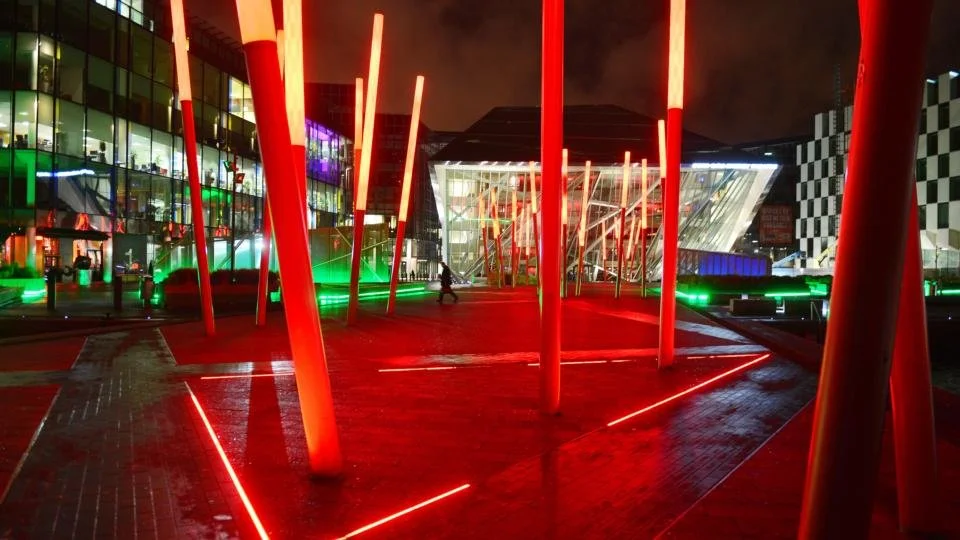
The icing on the cake, alongside the extended platform hanging over the water of the old industrial port basin, is a series of interesting glowing “pick up stick” style poles which jut 4-5 metres into the air in a seemingly irregular fashion. These upright forms work in tandem with the floor-level lighting emitted from below to draw the eye in and give a sense of meandering through luminous organised chaos. It remains a stirring work to this day. Heading over the MacMahon Bridge between Pearse Street and Ringsend, the nighttime scene is sure to catch the eye as you whistle by and take a glance at the elegant urbane feel to this pocket of the city. For contrast with how it looked before, if you’ve seen The Commitments (1988), this is where the final scenes of the movie were shot. A great film, but holy moly does Dublin look drab in it.
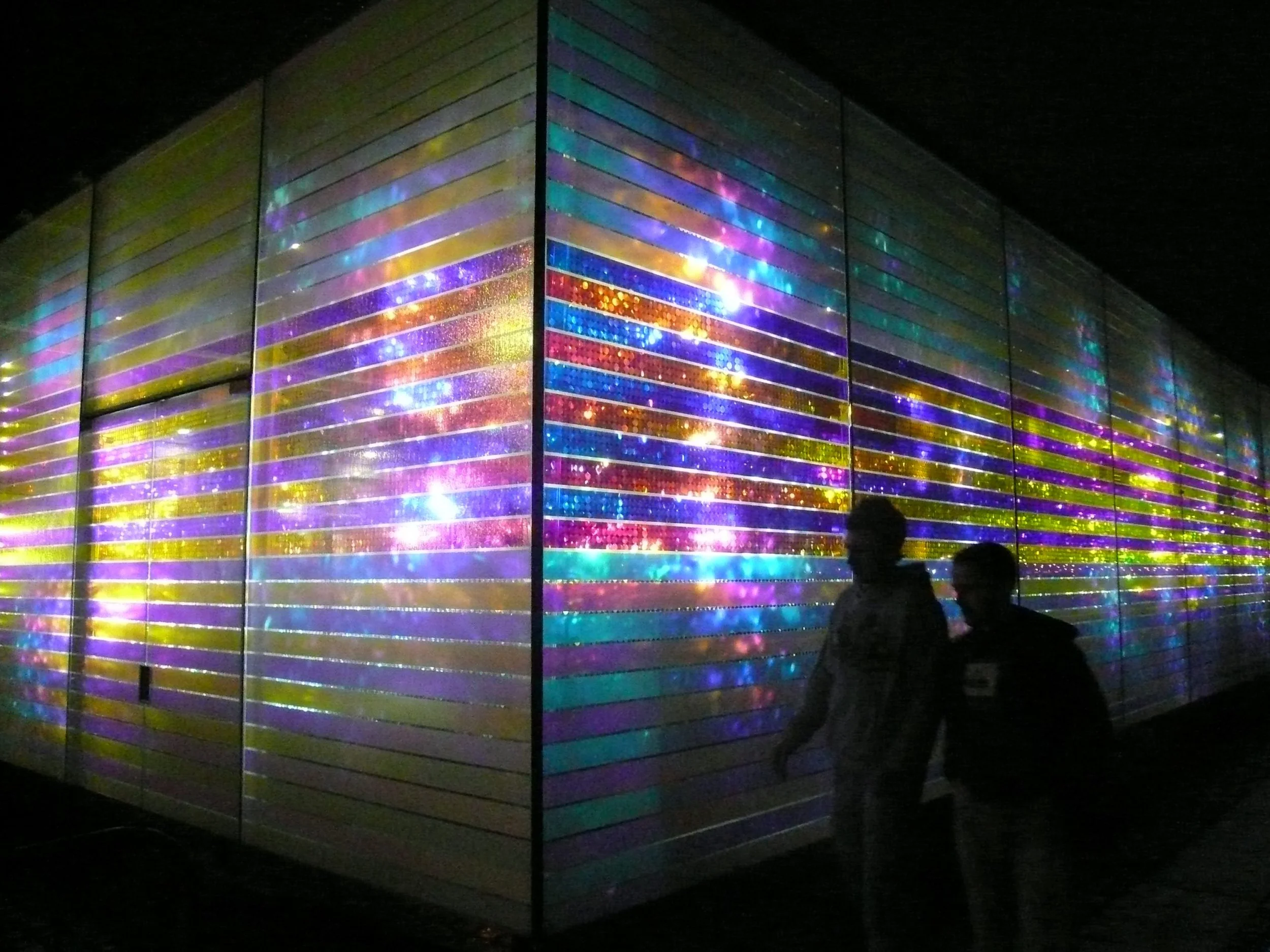
Flow: A Quayside Glow
Not every piece of public art from this era needed to commandeer a skyscraper or redesign a public square. 'Flow' (2009) by Martin Richman packed quite a punch in the small amount of space it took up on North Wall Quay. This was a brightly lit kiosk-type space. While you couldn’t get newspapers, chocolate bars or local gossip at this kiosk, it did serve up a dazzling light show for anyone passing by. Ringed with bold horizontal coloured stripes and a net of sequins encased inside a protective glass case, its shimmering look actually hid quite a humdrum functional piece of equipment - its primary job is to hide a pressure-reducing gas station. Rectangular in form, it seems to reference the shipping containers that were once such a prominent feature stacked along the docks. Still in situ today, it’s enjoyable to look at by day and night - by day, sun (when we can get it!) plays off the gently moving sequin shapes and by night, the sequin shine is further emboldened and with busy stripes that are lit up with ambient interior lights.
It’s a lovely little lit up nook and cranny in what’s now a much more active part of the city. In 2009, you got a sense that you were strolling around the city’s edge, as much of the north quays remained as undeveloped brownfield sites. While the brash signage of the 3Arena outshines the artwork-substation by its sheer wattage these days, “Flow” still stands as a charming piece of public art that keeps on humming regardless.
Why was there so much public art at this time?
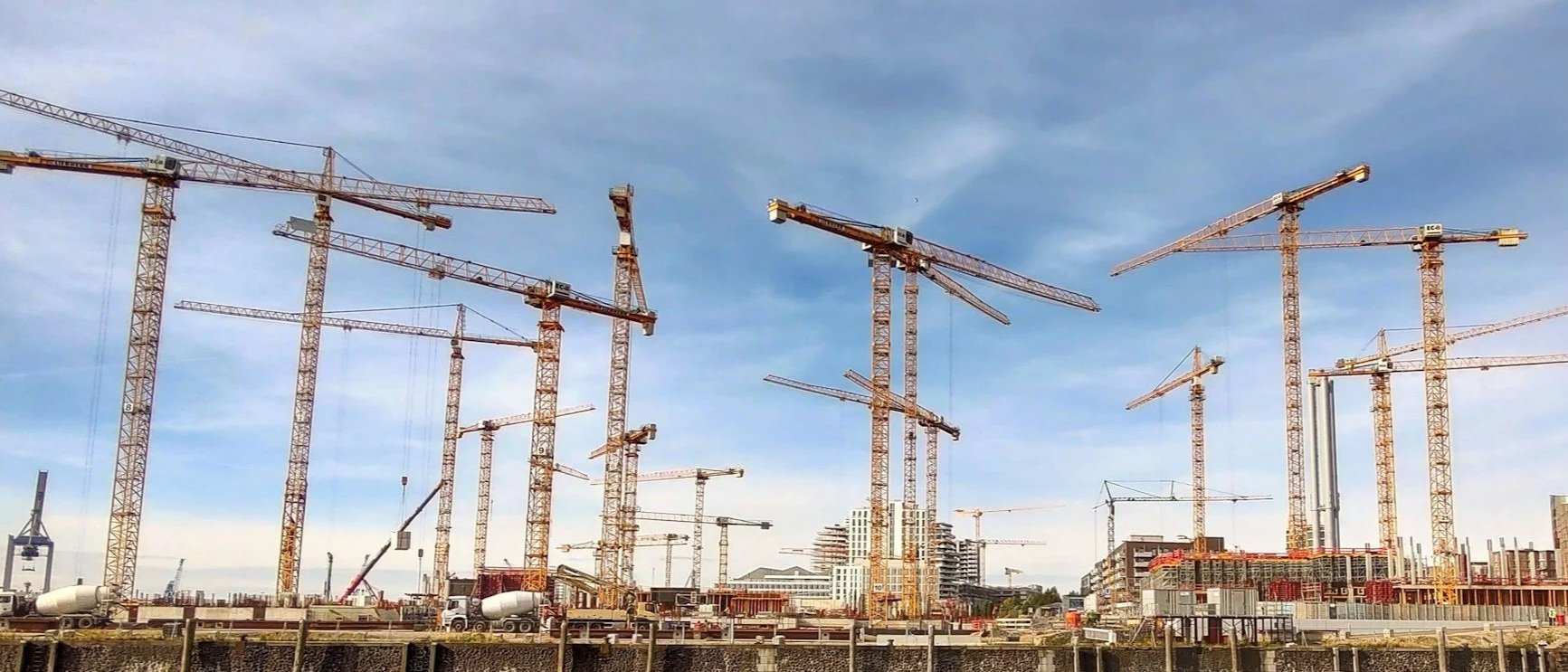
The timing was not accidental. Large-scale public installations take years to commission, plan and execute - most of what you see in this piece was likely green-lit somewhere between 2004 and 2007, at the absolute peak of Celtic Tiger spending. The economy had already begun to wobble by the time the scaffolding came down. Had the bubble not burst, this would probably have been but an opening chapter rather than the whole story.
Essentially, this was the peak period of the "Per Cent for Art" scheme, where a percentage of the cost of any public infrastructure project (such as the massive O'Connell Street regeneration) was ringfenced to be spent on art. Furthermore, while Dublin’s Theatre Festival of course continues to this day, the type of corporate sponsorship that it attracts nowadays would be much lower. In 2009, the festival was sponsored by Ulster Bank - an institution that, in the aftermath of the crash, ultimately decided Ireland no longer fit within its parent company's strategic priorities, and wound down its operations here entirely. From underwriting ambitious public art to shutting up shop: quite the arc. It doesn’t take a time machine to imagine that the funds they would have had to spill on arts sponsorship during the latter days of the Tiger years, would have been, to use a colloquial phrase, “silly money altogether”.
In many ways, it’s a pity such silly money isn’t on the go today. Corporate influence on art is a slippery pole for artists to navigate - the money that makes ambitious public works possible rarely comes without strings, and in the 2010s and 2020s that influence has become more insidious and harder to trace than a logo on a banner. The art tends to get safer. The logos get smaller. The strings get longer.
Final thoughts
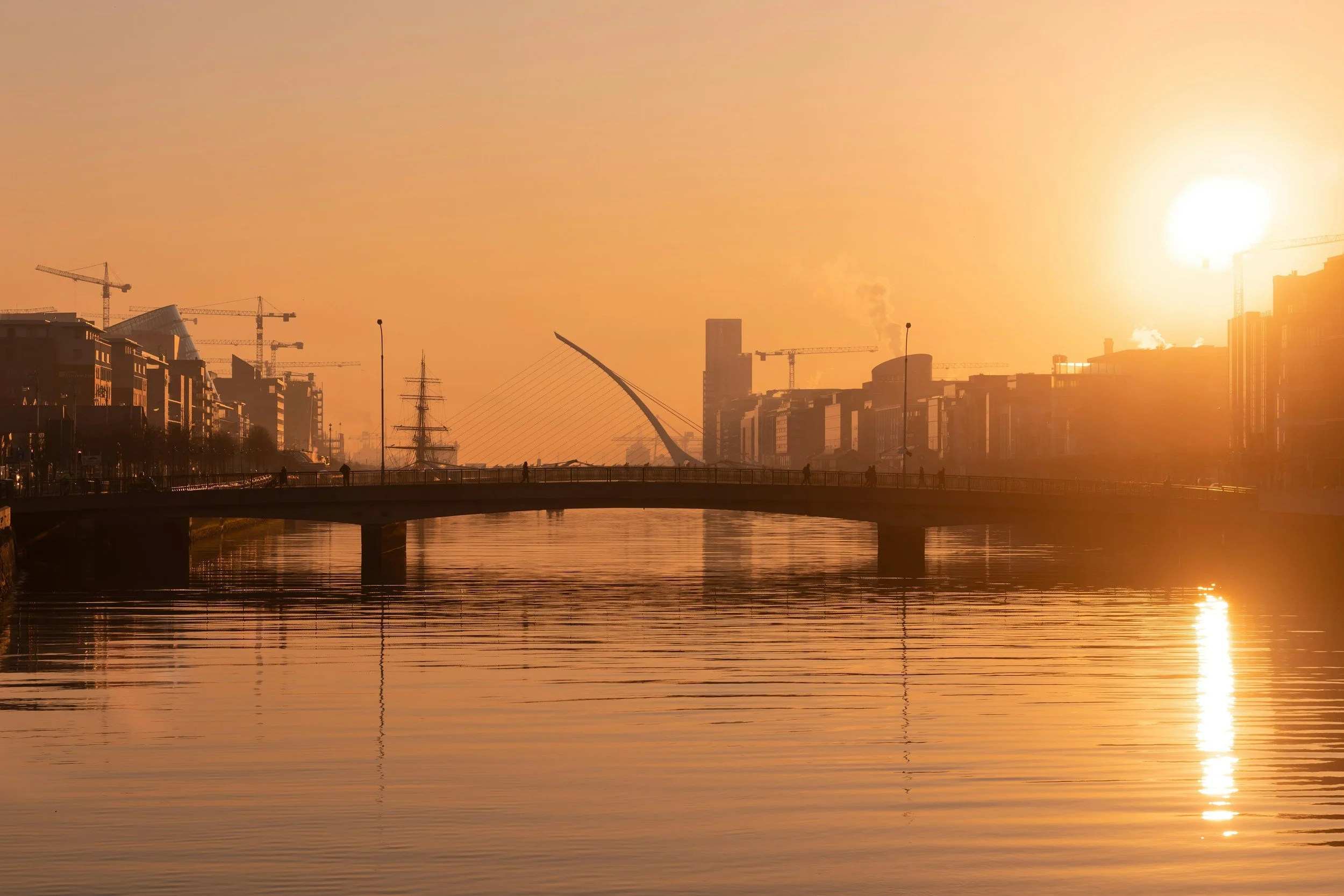
All in all, 2008-9 was a unique window of time where the city felt like an open-air digital gallery just before the realities of the economic crash rapidly hit home. As the lights dimmed on Julian on O’Connell Street and the Liberty Hall Playhouse, an era of ambitious - perhaps even hubristic - planning came to a halt. Among the shelved projects, some feel like deeply unfortunate missed opportunities, such as the “Angel of Dublin” - a planned colossal frame structure depicting a human form, which was to be installed sitting right in the River Liffey itself! This was designed by one of the defining public artists of modern times, Anthony Gormley, perhaps most well known for his “Angel of the North” on Tyneside.
Another planned structure, and yes, I’m going to put my credibility on the line, was the infamous “U2 Tower” near Grand Canal Dock. This would have been a sharply-slanted 18-storey tower with a recording studio up top. In the end, we got the unimaginative “Capital Dock”, proudly brought to you by the Kennedy Wilson investment fund: high enough on scale, low on character. Indeed, considering much of the Docklands ended up being filled up with 6-8 storey characterless mixed-use blobs, in retrospect I feel a U2 tower wouldn’t have been the worst thing after all.
Some other projects, mercifully, ended up on the architects’ cutting room floor, such as “The Ski Slope of O’Connell Street”. This would have been a shopping centre on the big street with an incomprehensible and hideous steep angled top on it, envisioned by bigman propertyguy Joe O’Reilly, presumably during a disorientating fever dream.
And so we leave the luminous Dublin of this brief, brilliant window behind - a city that dazzled itself on the way down. But as for the Dublin that never got to exist at all, that's a story for another day.
In a future article, we’ll look at The Dublin That Almost Was: the phantom skyline of skyscrapers, Liffey giants, and weird ski slopes that never left the drawing board.
