

The Best Pubs in Dublin for a Proper Conversation
Dublin pubs have a reputation, and it’s mostly deserved. Yes, some of them involve standing near a speaker while someone shouts Ed Sheeran lyrics two feet from your face. But the city also has another kind of pub entirely - the kind where a stranger leans over, says something sharp or funny or completely unexpected, and ten minutes later you have been declared “gas craic” by someone whose name you never caught. Conversations here tend to be brief, combustible, and oddly memorable. Occasionally they go long, and you’ll be swapping anecdotes until the barman is flicking the lights for you to leave. Either way, you need the right room.
Here are six that reliably deliver.
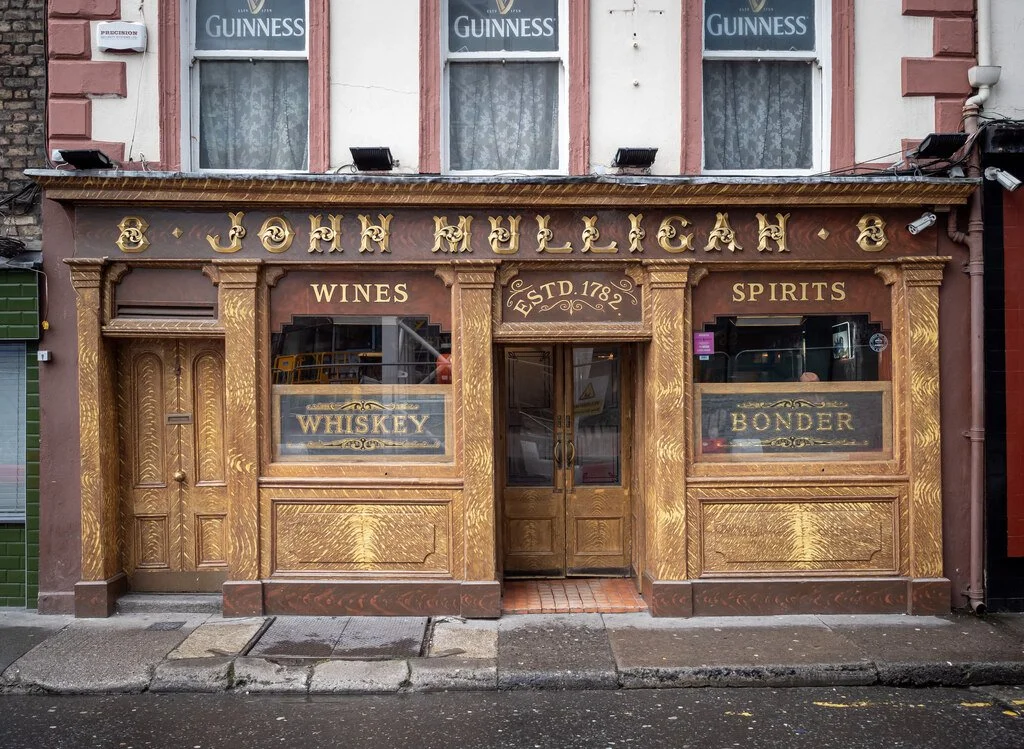
Mulligans, Poolbeg Street
Mulligans requires a small detour, and the detour is worth it. Tucked down Poolbeg Street - a short walk from the city centre but oddly removed from it - the pub sits on a site that has been serving drink since the early Middle Ages. The current building has been here since 1782. It does not feel especially concerned with impressing you, which is part of the appeal.
Step inside and the city falls away. It is not a small pub, but it has a circular route around a central bar, with snugs and nooks branching off in all directions, and the effect is of a place where you can easily get lost - in the best sense. There is rarely music, rarely a television on, and the Guinness is taken seriously. The atmosphere does the rest.
The surroundings outside are their own kind of Dublin story. Poolbeg Street sits in an in-between zone - old dark lanes that once ran down to the docks, now hemmed in by gleaming new office developments built for the tech firms that have colonised this part of the city. Glass and steel everywhere, and then this narrow old building holding its ground. It is a good metaphor for Dublin if you are in the mood for one, and after a pint or two, you probably will be.
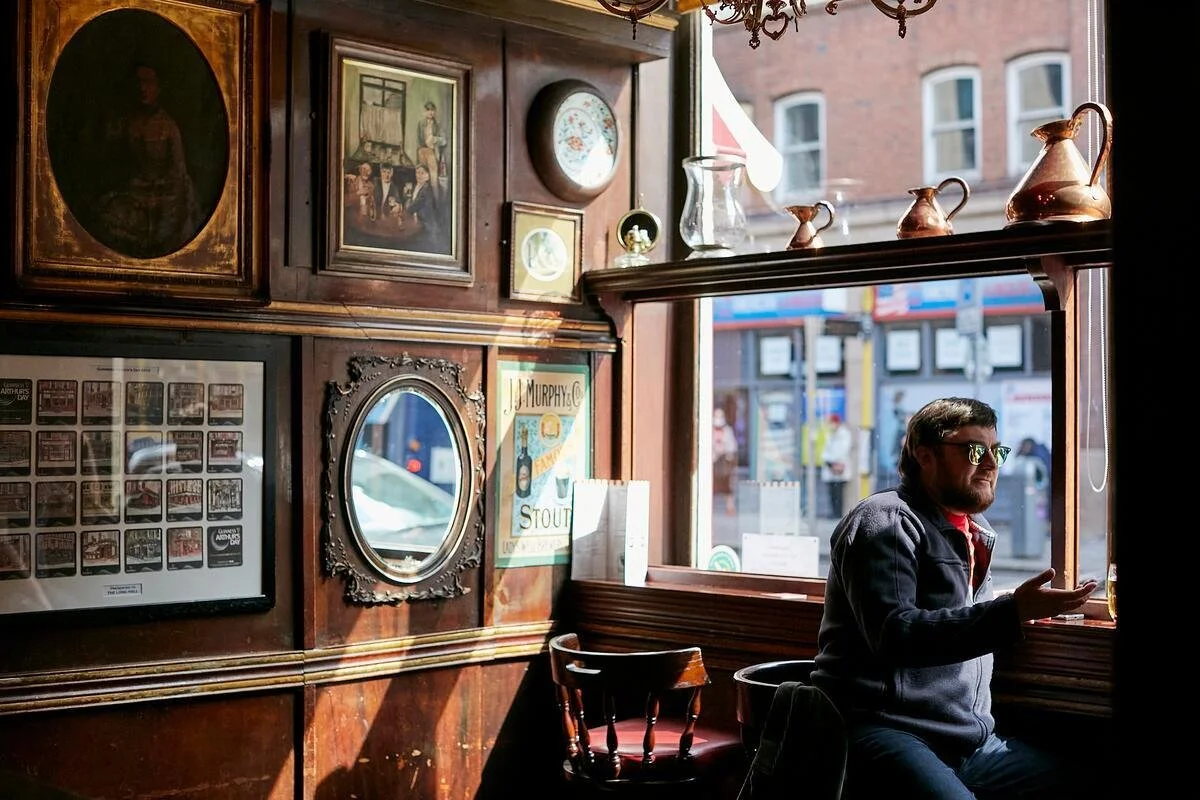
The Long Hall, George's Street
The Long Hall looks the part. A long Victorian bar stretching back from the street, ornate mirrors, dark wood, clocks that may or may not be telling the correct time. It is a beautiful pub. On a busy evening, it is also extremely packed.
This is not a complaint. The Long Hall operates on the principle that proximity is its own social lubricant. There is practically no option to sit. You stand, you press up against strangers at the bar, you edge sideways towards the bathroom with a muttered “excuse me”, and en route you have a conversation with someone you have never met. The layout does not just allow this - it creates it.
Afternoons are quieter if you want more room to breathe. Come evening, and weekends especially, expect the full experience.
As a little aside, and in testament to the conversational vibe, the name of the pub is both an accurate description of its layout: it is literally a long hall room. But there’s also a little nod to the chat in there, which is considered so good in this pub, that you’re in there “for the long haul” even if you intended on just the one drink.
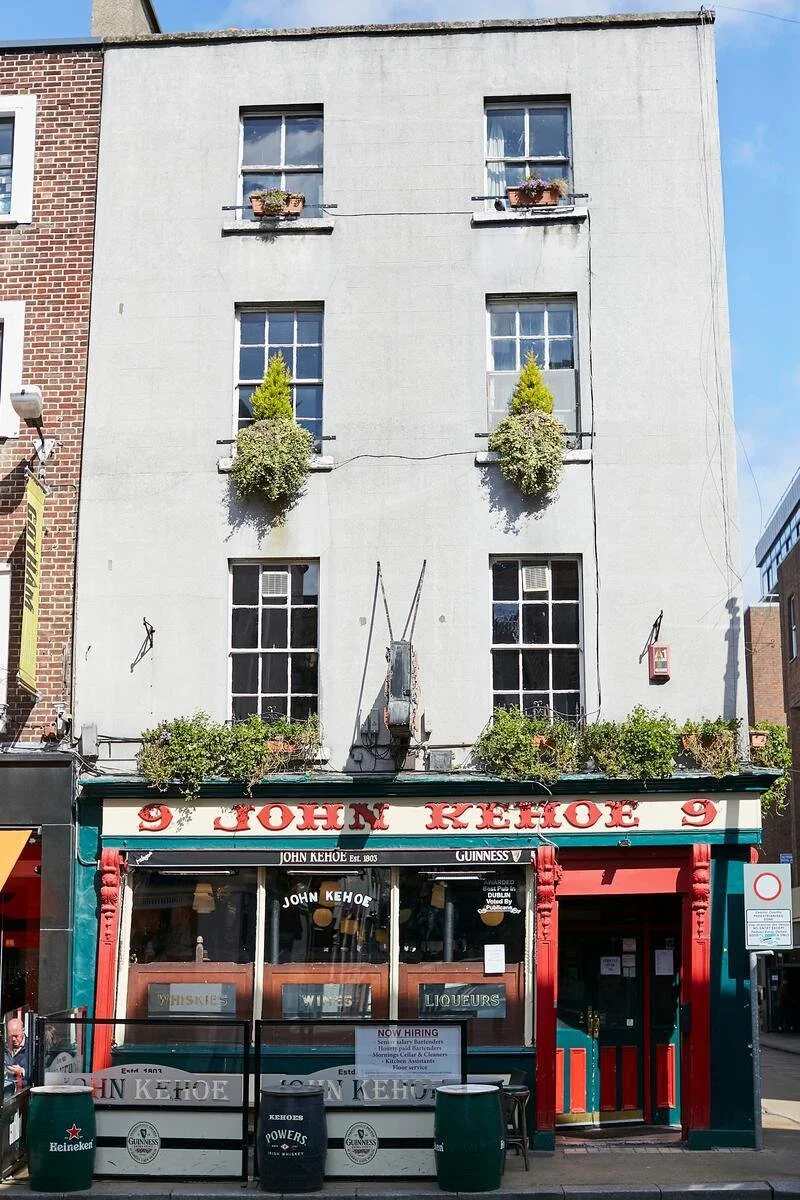
Kehoes, South Anne Street
Kehoe’s is central - just off Grafton Street - but it manages not to feel like a tourist pub, which at that location is something of an achievement. The Victorian interior is genuinely original: old snugs, dark wood, a bar that has clearly been there a very long time. The upstairs room is worth knowing about. What were originally the pub owner's private living quarters have been converted into small sitting rooms, each with their own atmosphere. Get a spot up there and you will understand why people come back to this pub repeatedly.
But the real action on a fine day is outside. Kehoe's spills onto South Anne Street in a way that few pubs in the city manage as well, and on a sunny afternoon the street fills up with pints and conversation in equal measure. The pub does not have a formal outdoor area so much as the pavement simply becomes part of it. People of all stripes and backgrounds congregate here, and standing wedged in on the path or by the curb is quite the social leveller. If you want to experience Dublin pub culture at its most social and least formal, this is where to stand.

Grogans, South William Street
Grogan's doesn’t try. There is no food beyond toasted sandwiches, no music, and no décor that suggests anyone spent a lot of time on it. The walls are covered in work by local artists - paintings, prints, pieces you can actually buy - and it functions quietly as a gallery as well as a pub, which is about as far from the snuffy, white-cube gallery experience as it is possible to get.
The crowd runs to artists, writers, people who have been coming here for thirty years, and people who wandered in for the first time. Nobody seems to mind which category you are in. It’s one of those pubs where a stranger will simply start talking to you, and this is not considered strange. The pub is regularly full on the inside, but that’s fine, as sitting outside people watching is a quintessential Dublin pub experience too. The streets around Grogan’s are where the fashionable youth of the city tend to flock.
One house rule worth knowing: there is no singing. This is enforced. A friend of mine once started up a song at the bar and the barman raced over to shut him up before he had finished the first line! The absence of music is a feature, not an oversight. The conversation is the entertainment.
Toners, Baggot Street
Toner's is on Baggot Street, a short walk from St Stephen's Green, and it is one of Dublin's pubs with a well-documented literary connection: W.B. Yeats - who famously had no love for pubs - is said to have visited Toner's, declared it his one and only visit to a public house, and left. Given that Yeats's idea of a wild Friday night tended more towards seances and mystical visions, perhaps he was simply put out by the lack of ouija boards on the premises.
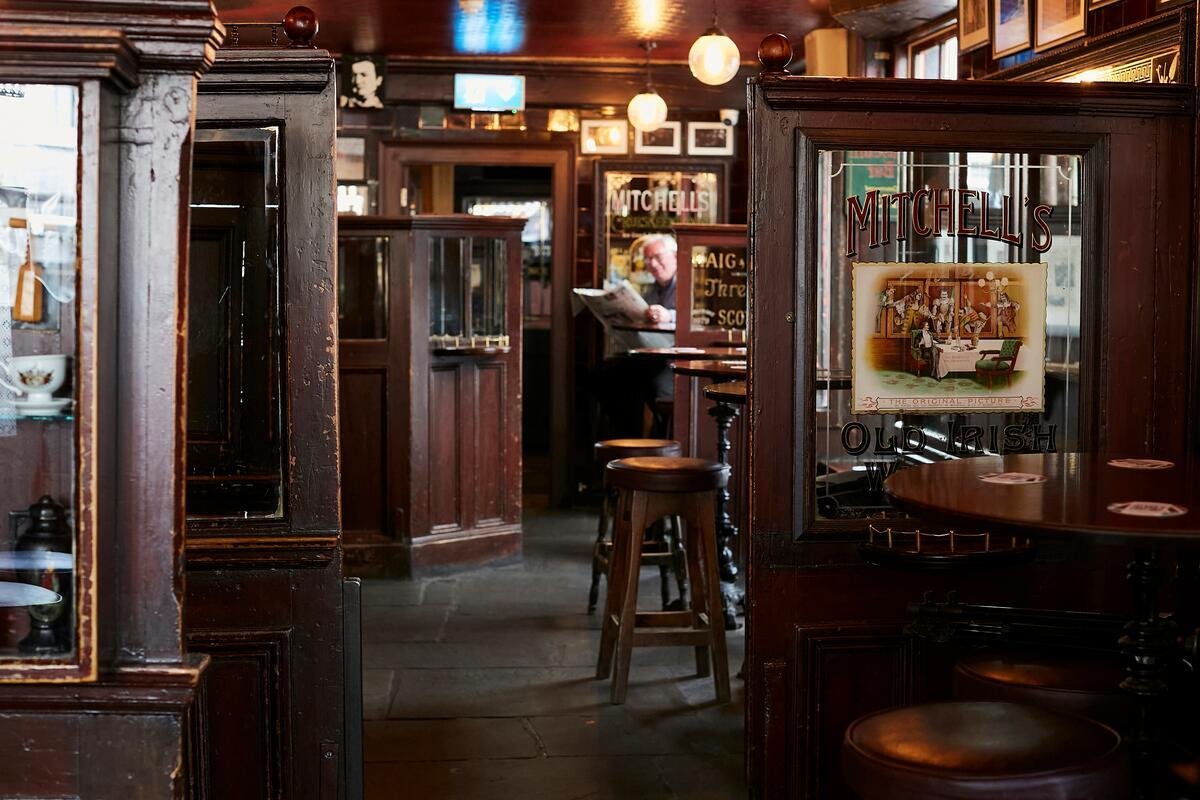
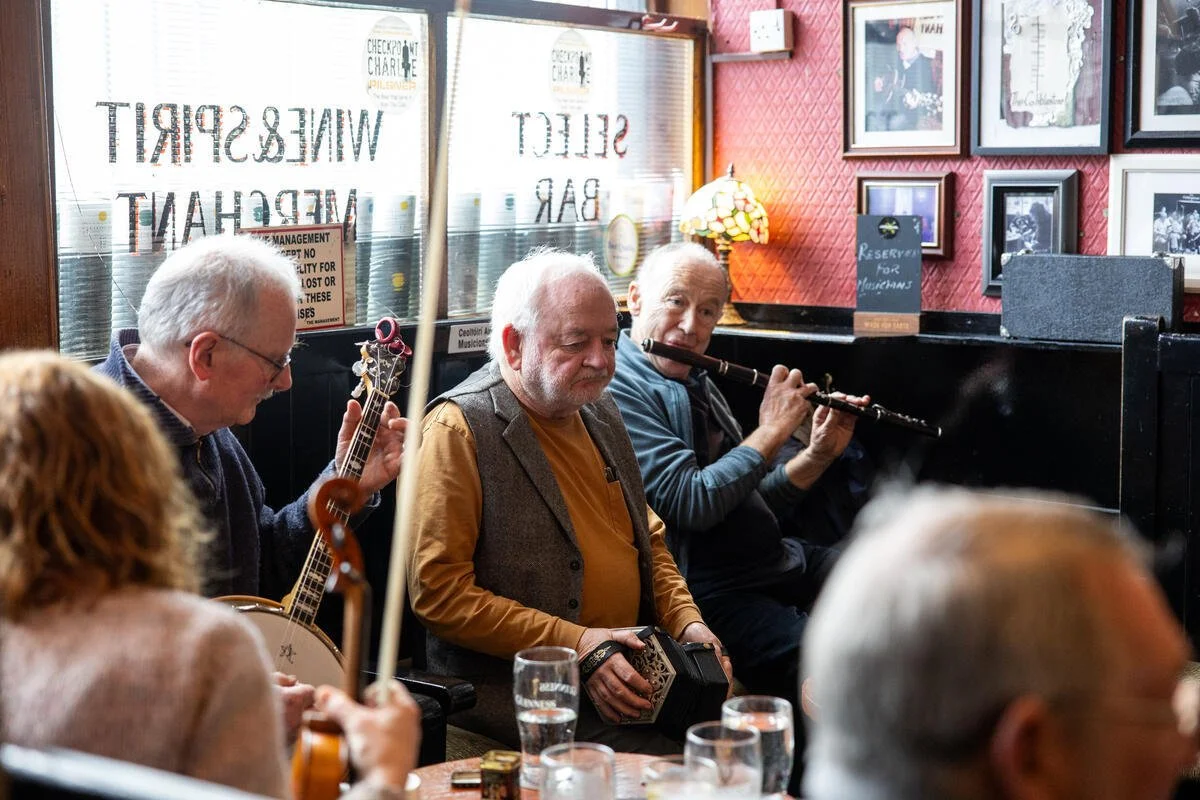
The pub itself is a proper Victorian snug, dark and well-worn in all the right ways. The trad sessions here - usually at weekends - are among the better ones in the city for this kind of evening. Traditional sessions are not a sit-in-silence affair; they are designed to be experienced while conversation is happening around them, and Toner's gets that balance right. The music fills the room without taking it over.
This is not a “no TVs” pub, just to note. While they’re often turned off, actually Toners is one of the best pubs in the city to experience a sports game being shown - especially for rugby and GAA.
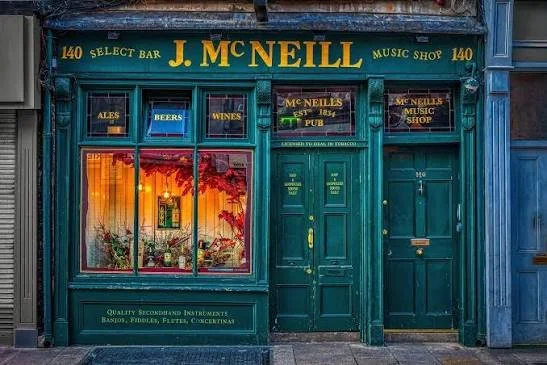
McNeills, Capel Street
Capel Street is one of the more intriguing streets in Dublin: Balkan patisseries, independent tailors, a sex shop or two, some of the best falafel in the city, and a clutch of classic Dublin pubs that have been here long before the street became fashionable. McNeill's is the most reliable of them for conversation and that specific warm, unpretentious atmosphere that is harder to find than it should be.
The frontage alone is worth a look before you go in - a deep teal shopfront with "J. McNeill" lettered above the door and a dainty display of musical instruments in the window that looks like something from a different century, which, indeed, it is. McNeill’s began life as a music shop in 1834, moved around the street a little over the decades, and has been in situ in its current location as a pub-only operation for the past couple of decades. Inside it is a small, slightly poky place - dark wood, an ornate cast-iron fireplace, framed photographs on the walls, a few snug-like areas, and a compact upstairs section that requires some nimble footwork to navigate on a busy night.
The trad sessions here have a local following. Of all the pubs on this list, McNeill's is probably the one where you are least likely to find yourself around tourists. It is a notch quieter than the others on this list as a result - less of a buzzing room, more of a settled one - but if you do strike up a conversation here, it tends to go somewhere. The welcome is genuine, and so is the chat.
If you have been sticking to the southside, Capel Street is well worth the walk across the river.
Last Orders: a note before you go
One thing that catches visitors off guard: the rounds system. If you are drinking with a group of Irish people, someone will buy a round for everyone at some point. This rotates across the evening - the unspoken expectation is that each person takes a turn. If a local buys you a drink, make a visible effort to return the favour before the night is out.
One extra wrinkle: if you offer to buy an Irish person a pint, they will probably refuse the first time. They almost certainly do not mean it. Ask again. Ask a third time if needed. Three refusals in a row means no. One or two means yes, go on then, since you're insisting.
As for what to talk about and what to approach with a degree of care - that probably deserves its own piece, which we will get to in an upcoming post.
Go in open, be willing to disagree politely, and the pubs will do the rest.
